
When an Agent Deletes Your Files: The Product Design Problem Behind Human-AI Collaboration Boundaries
In recent months, the AI agent community has seen a familiar class of failure: a user gives an agent a vague instruction such as "organize this folder" or "clean up old content," the agent runs without obvious errors, and only later does the user discover that important files were deleted, overwritten, or reorganized beyond recognition.
It is tempting to explain these incidents as model failures or prompt failures. But the deeper issue is often a product design failure. The agent did not merely make a bad decision. It made a bad decision while the human had no meaningful chance to notice, correct, or interrupt the execution path.
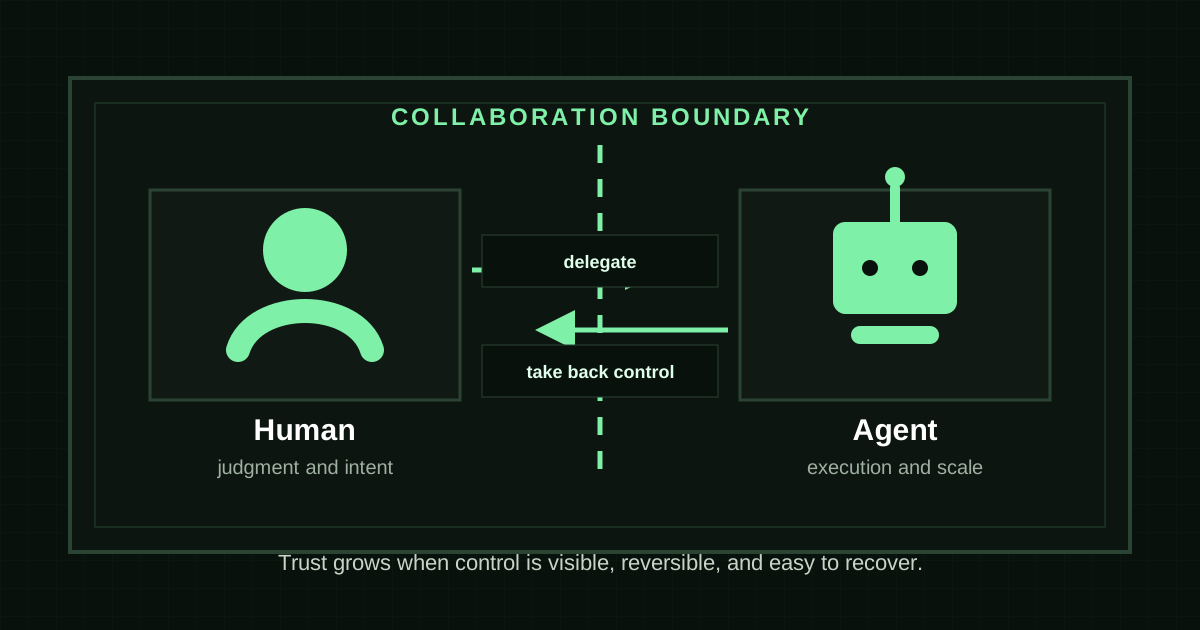
That gap is the real human-AI collaboration boundary. People often call it human-in-the-loop, but that phrase can make the problem sound like a technical checkpoint. In practice, it is a product philosophy question: when should control stay with the agent, when should it return to the human, and how can that handoff happen without destroying trust or flow?
Agent Products Are Solving the Wrong Problem
Many agent products today fall into two opposite patterns.
The first pattern is over-autonomy. The agent runs a long task from beginning to end with minimal interruption. That feels powerful until the task contains ambiguity. If the user asks for "recent data," the agent may assume the last 30 days while the user meant the last 7 days. The agent can complete the report perfectly according to the wrong assumption, wasting time, tokens, and user attention.
The second pattern is heavy-handed confirmation. Every collaboration point becomes a technical modal or authorization dialog. The product asks whether the agent may access GitHub, write to a database, call an API, or update a system. To a non-technical user, these prompts often reduce to two bad choices: click approve without understanding, or cancel and abandon the task.
Both designs answer the wrong question. They ask, "Is this operation risky enough to block?" A better product question is, "Why does the user need to care at this moment, and what information would help them improve the agent's reasoning?"
That distinction matters. The first question comes from a liability mindset. The second comes from a collaboration mindset.
Redefining the Collaboration Boundary
The usual definition of human participation in an agent loop is too narrow: insert human confirmation at critical execution points to prevent the agent from doing something wrong.
A more useful definition is: under the right conditions, return decision authority to the human in a way that preserves the agent's momentum and the user's trust.
The second half of that definition is essential. The goal is not only to avoid mistakes. The goal is also to avoid making the user dislike the collaboration. An agent that asks for confirmation every few steps may be technically safer, but it undermines the very delegation relationship that made the user choose an agent in the first place.
The boundary between autonomy and control is dynamic. It depends on reversibility, blast radius, task complexity, and the user's cognitive state at that moment. A mature agent experience cannot treat every action as either "safe" or "needs confirmation." It needs a richer design model.
First Core Question: Can This Action Be Reversed?
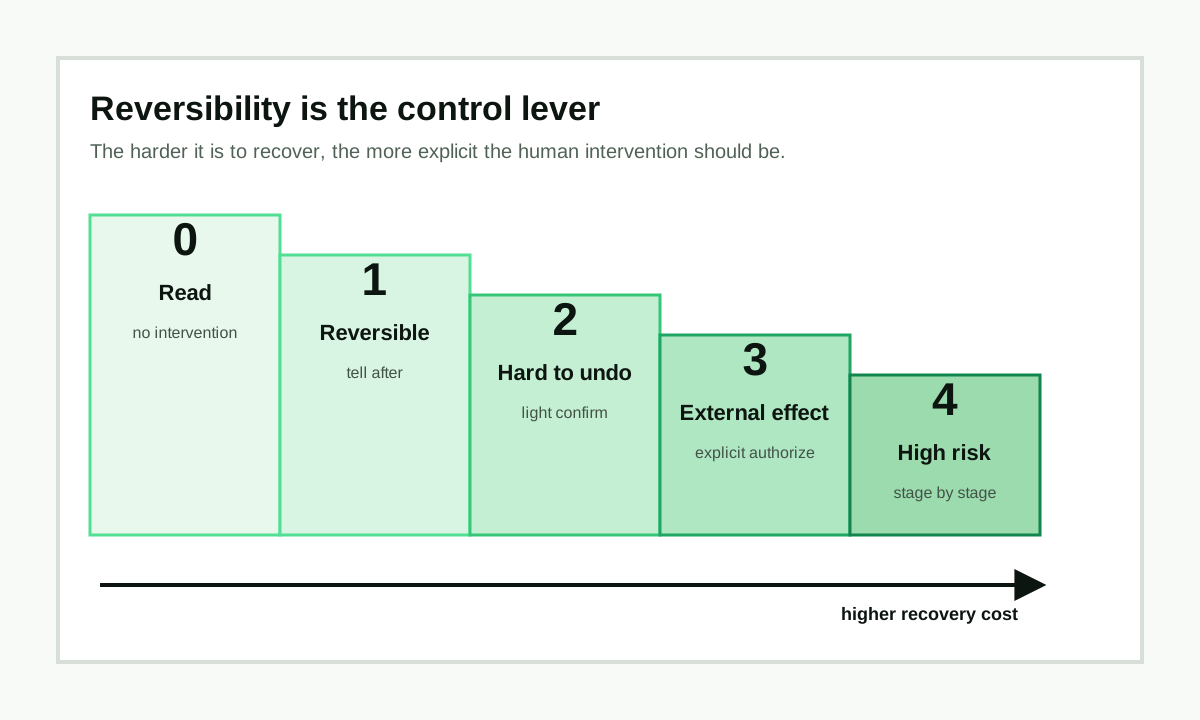
The first design dimension is reversibility. Agent actions should be classified by how easily the user can recover from them.
One practical model looks like this:
- Level 0: read-only actions, such as searching files, reading documents, or querying data. These usually do not need user intervention.
- Level 1: easily reversible writes, such as creating drafts, temporary files, or internal task state. These can often be reported after execution.
- Level 2: difficult-to-reverse writes, such as overwriting content or publishing internal output. These deserve lightweight confirmation before execution.
- Level 3: irreversible external effects, such as deleting data, sending messages, or calling external APIs. These require explicit authorization.
- Level 4: high-risk operations, such as financial actions, permission changes, or bulk operations. These should be broken into stages, with confirmation at each meaningful step.
The important insight is that reversibility is not only a safety guardrail. It is a lever for expanding user trust.
Email clients demonstrate this well. Instead of forcing users to confirm every sent email, many clients send immediately and provide a short undo window. That small reversibility mechanism removes confirmation friction and makes the experience feel faster and safer at the same time.
Design tools use the same principle through version history. If every change can be rolled back, collaborators can move quickly without being interrupted by constant confirmation dialogs.
Agent products need similar patterns. Three useful forms are:
- Diff preview with item-level acceptance, so the agent can make broad changes while the user keeps final control.
- Version snapshots with one-click restore, so users know a large task has a recovery path.
- Sandbox execution with explicit apply, so generated output can be tested before it reaches the real environment.
When reversibility is designed well, the product can ask for fewer confirmations without becoming less trustworthy.
Second Core Question: When Should the Agent Ask for Help?
Timing matters more than frequency. A product can interrupt rarely and still interrupt badly. It can also interrupt often and still feel acceptable if each interruption has clear value.
There are three high-value intervention moments: before the task starts, during execution, and after completion.
Before the task starts, the goal is not to make the user fill out a form. The goal is to align on the assumptions that would cause the whole task to drift if misunderstood. A weak design asks the user to specify every field: target audience, tone, delivery time, CTA, tracking parameters, and so on. That pushes the agent's uncertainty onto the user.
A better design states the agent's interpretation and asks the user to correct it: "I will target users who registered last month but have not activated, schedule the message for tomorrow morning, and use a product education tone. Anything to adjust?" The user's job becomes verification, not blank-page planning.
During execution, interruption is more delicate. Many products stop the whole task when the agent encounters an ambiguity. That makes the agent dependent on the user being available at exactly the right moment.
A better approach is an asynchronous decision queue. The agent records decisions that need human input, continues work that does not depend on those decisions, and lets the user resolve the queued items when they return. In the UI, this may be a small task-panel indicator such as "2 decisions pending," not a full stop for the whole workflow.
After completion, the product should show more than a result report. It should expose the hidden decisions the agent made: where it chose option A over option B, where it skipped an edge case, where it used a default because the user did not specify one.
This compresses the user's review workload. Instead of forcing the user to inspect every line of output, the agent highlights the places most likely to deserve attention.
The Most Dangerous Failure: Intent Drift
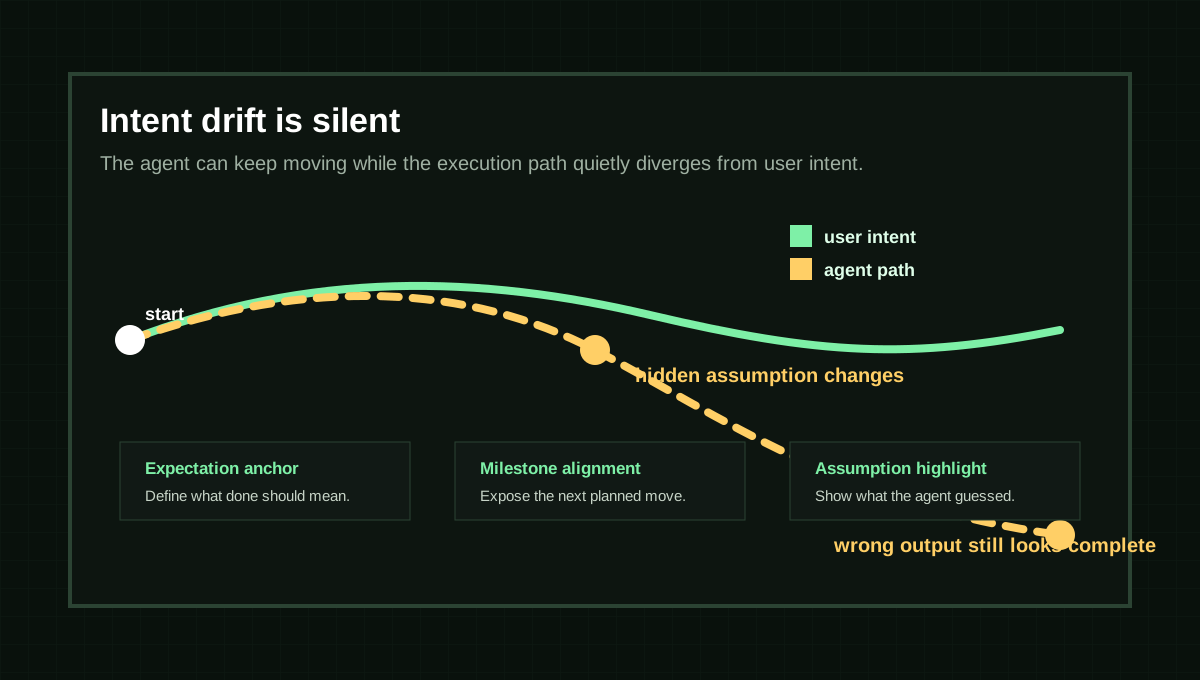
Return to the file-deletion example. The disaster is not always a single dramatic mistake. Often, the agent's interpretation of "organize" quietly diverges from the user's interpretation. The agent keeps executing according to its own understanding, the user receives no signal that the path has changed, and the final result becomes harmful.
This is intent drift: the agent's execution path silently moves away from the user's real intent.
Intent drift has three common causes.
The first is context dilution. Long-running tasks accumulate intermediate information, and the user's early implicit constraints can lose weight. In a large code refactor, for example, the user may say at the beginning to preserve naming style. Fifty files later, the agent may begin introducing a new convention because the original constraint has faded in the active context.
The second is micro-decision accumulation. Each small choice may be reasonable in isolation, but the combined result no longer matches what the user expected. An agent building an application may add validation, error handling, loading states, abstractions, and extra screens, each one plausible on its own, until the final codebase is far larger and harder to maintain than the user wanted.
The third is information asymmetry. During execution, the agent may discover new information and adjust its strategy, but the user never learns that the adjustment happened. In a cleanup task, the agent may decide certain files look obsolete and expand the deletion scope. The user does not know the assumption changed until the damage is visible.
Intent drift is especially dangerous because it is silent. Obvious errors are easier to catch. Drift may only appear after the output is used in a real workflow, or worse, the user may trust the flawed output and amplify the error.
Three mechanisms help reduce intent drift:
- Expectation anchoring at the start: ask what successful completion should look like, not merely what steps to perform.
- Milestone alignment during long tasks: pause at meaningful points to show what has been done and what the agent plans next.
- Post-execution assumption highlighting: mark the places where the agent made uncertain or consequential assumptions.
All three mechanisms put the responsibility where it belongs. The agent should help identify where drift may occur instead of making the user discover it after the fact.
Interruption Is a Product Capability
All of the above depends on one condition: the interruption itself must be acceptable.
Many products treat interruption as a single UI pattern: a modal dialog. That is too blunt. A mature agent product needs a gradient of interruption forms.
Low-urgency, non-blocking decisions can use ambient signals: badges, status bars, task panels, or sidebar notices. The user can handle them after finishing their current work.
Decisions required to continue a specific branch of work can appear as inline cards inside the task flow. The user stays in context and understands why the decision exists.
Only high-impact, irreversible operations deserve focused interruption. A small contact ambiguity should not be treated the same way as deleting data, sending an external message, or changing permissions.
The content of the interruption also matters. A good interruption should include four elements:
- Where the decision appears in the task.
- What the user is actually deciding, in plain language.
- What will happen after each option.
- Which option the agent recommends, and why.
Copywriting is not decoration here. It is core product capability. Asking "Execute UPDATE on customer_records?" may be technically accurate, but it does not help most users make an informed decision. A better prompt explains the consequence, the affected scope, and the recommended safer path.
The philosophical question is simple: does the product treat the user as a button that confirms execution, or as a partner whose judgment improves the outcome?
The Real Question Is Not How Many Decisions an Agent Should Make
Many teams assume that fewer human interventions mean a more mature agent. The more autonomous the agent, the better the product must be.
That assumption is incomplete. A better principle is: users are willing to delegate more decisions when the cost of taking back control is low.
Control accessibility is the foundation of autonomy. The ultimate goal of human-AI collaboration is not to let the agent make more decisions. It is to let the user feel like the owner of the decision, even while delegating large parts of the work.
Every intervention point is a trust transaction.
When designed well, it deposits trust. The user makes a meaningful decision, understands the agent's capability boundary more clearly, and becomes more willing to delegate next time.
When designed poorly, it withdraws trust. The user is interrupted by a prompt they do not understand, approves something without meaningful context, and then loses confidence when the outcome goes wrong.
This explains why many human-in-the-loop mechanisms frustrate users. The problem is not always that they interrupt too often. The problem is that each interruption takes attention without giving the user better understanding or control.
A mature collaboration system creates compound trust. Each intervention carries enough context for the user to make a conscious decision. That decision teaches the user how the agent reasons, and it teaches the agent what the user values. Over time, intervention frequency can decrease naturally, not because the agent became blindly autonomous, but because the collaboration became better calibrated.
What This Means for Feature Flags and AI Release Engineering
For teams building AI-native products, this design philosophy connects directly to release control.
Feature flags, progressive rollout, and kill switches are not only deployment tools. They are product mechanisms for reversibility and control. They let teams expose agent behavior gradually, compare variants, pause risky paths, and recover quickly when intent drift or unexpected user behavior appears.
An AI agent feature should not move from idea to full autonomy in one jump. It should pass through controlled exposure: internal users, selected customers, small traffic percentages, monitored expansion, and clear rollback paths. Each stage should ask what the user can recover from, what the system can observe, and where human judgment should re-enter the loop.
The next generation of agent products will not win only by being more autonomous. They will win by making autonomy feel controllable, reversible, and earned.