
GrowthBook AI Experimentation Alternative: When FeatBit Fits Better
If you are searching for a GrowthBook AI experimentation alternative, you probably do not need another generic A/B testing definition. You need to decide whether your AI experimentation workflow should center on warehouse-native experiment analysis, or on a release-control layer that owns exposure, rollback, audit, and lifecycle cleanup for AI behavior in production.
GrowthBook is a serious product in this category. Its public pages emphasize feature flags, experimentation, product analytics, warehouse-native metrics, AI-agent workflows, controlled model and prompt experiments, approval flows, and self-hosted options. This article does not claim that GrowthBook cannot support AI experimentation.
The useful alternative question is narrower: when should a team evaluate FeatBit instead because the primary job is release control for AI changes, not only experiment analysis?
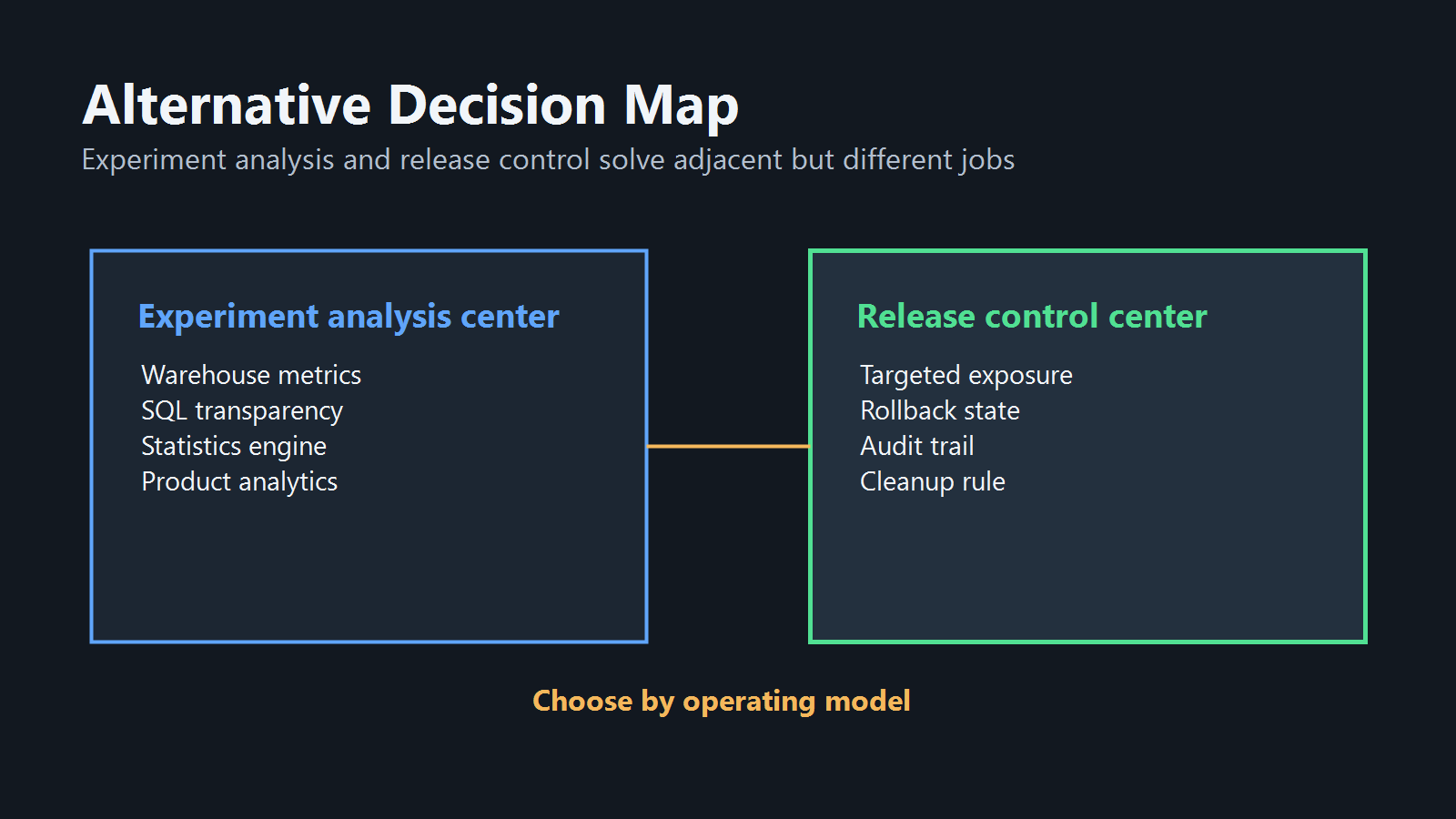
The Alternative Question Is Really An Operating Model Question
AI experimentation can mean several different jobs:
| Job | What the team is trying to decide | Common control surface |
|---|---|---|
| Prompt comparison | Which prompt should become the default for a user journey? | prompt version flag |
| Model route experiment | Which model or provider route improves quality without breaking cost or latency guardrails? | model routing flag |
| RAG configuration test | Which retrieval profile improves answer usefulness and citation quality? | retrieval profile flag |
| Agent behavior release | Which tool authority, approval mode, or fallback behavior is safe for a segment? | agent mode or tool policy flag |
| Product AI feature rollout | Which accounts should see the AI feature, and when should it expand? | feature access and rollout flags |
GrowthBook's AI software page frames AI experimentation around controlled experiments for prompts, agents, performance, latency, cost, user satisfaction, and custom product metrics. Its experimentation page emphasizes warehouse-native metrics, SQL-defined business measures, Bayesian or frequentist engines, sequential testing, CUPED, guardrails, and workflows.
Those are valuable when experiment analysis and metric transparency are the center of the decision. FeatBit becomes worth evaluating when the decision starts earlier and ends later: define the AI release hypothesis, gate the behavior, expose the right segment, collect evidence, roll back precisely, record the decision, and clean up temporary controls.
That is why FeatBit treats feature flags as release-decision infrastructure, not only as code toggles.
When GrowthBook May Be The Better Fit
Use GrowthBook as the reference option when your team mainly wants a warehouse-native experimentation and analytics workflow.
GrowthBook's public positioning is strongest for teams that want:
- experiment analysis directly against an existing data warehouse;
- SQL-visible metrics and reproducible analysis;
- feature flags, experiments, and product analytics in one product workflow;
- built-in statistical options such as Bayesian, frequentist, sequential, bandit, CUPED, and SRM checks;
- AI-agent access to flags, rollouts, experiments, analytics queries, winner decisions, and stale flag cleanup through MCP or REST;
- the same agent guardrails, approvals, role-based permissions, environment scoping, and audit trail that GrowthBook exposes to human users.
That is a legitimate operating model. If your data team owns experiment trust through the warehouse, and the buying problem is "how do we analyze AI experiments with our existing metrics," GrowthBook should stay on the shortlist.
When FeatBit Is A Strong Alternative
FeatBit is the stronger alternative candidate when the buyer's problem is not "Which dashboard analyzes experiments?" but "Which control plane should govern AI behavior in production?"
Evaluate FeatBit when these needs are primary:
| Need | Why it matters for AI experimentation | FeatBit angle |
|---|---|---|
| Release control first | AI changes should not go from eval result to full production by default. | Use flags for internal targeting, canary exposure, percentage rollout, and rollback. |
| Reversible AI behavior | Prompts, models, retrieval, and agent modes can fail by segment. | Keep the baseline behavior reachable without redeploying. |
| One control plane for AI and non-AI releases | Platform teams often do not want a separate AI-only release stack. | Use the same flag, targeting, audit, and lifecycle model for ordinary features and AI behavior. |
| Self-hosted ownership | Flag state, experiment events, audit history, and user attributes may be operationally sensitive. | Evaluate FeatBit's open-source and self-hosted deployment model. |
| Lifecycle cleanup | AI experiments create many temporary prompts, routes, event names, and flags. | Give each experiment control an owner, evidence rule, review date, and cleanup path. |
| Agent-safe operations | AI agents can help create flags and experiment plans, but production changes still need deterministic controls. | Use FeatBit API, MCP, CLI, webhooks, and review workflows around a release-decision model. |
FeatBit's AI experimentation, AI control layer, safe AI deployment, and feature flag lifecycle management pages explain this operating model in more detail.
A FeatBit-Centered AI Experimentation Workflow
A FeatBit alternative evaluation should be based on the workflow you need to run, not on a feature checklist.
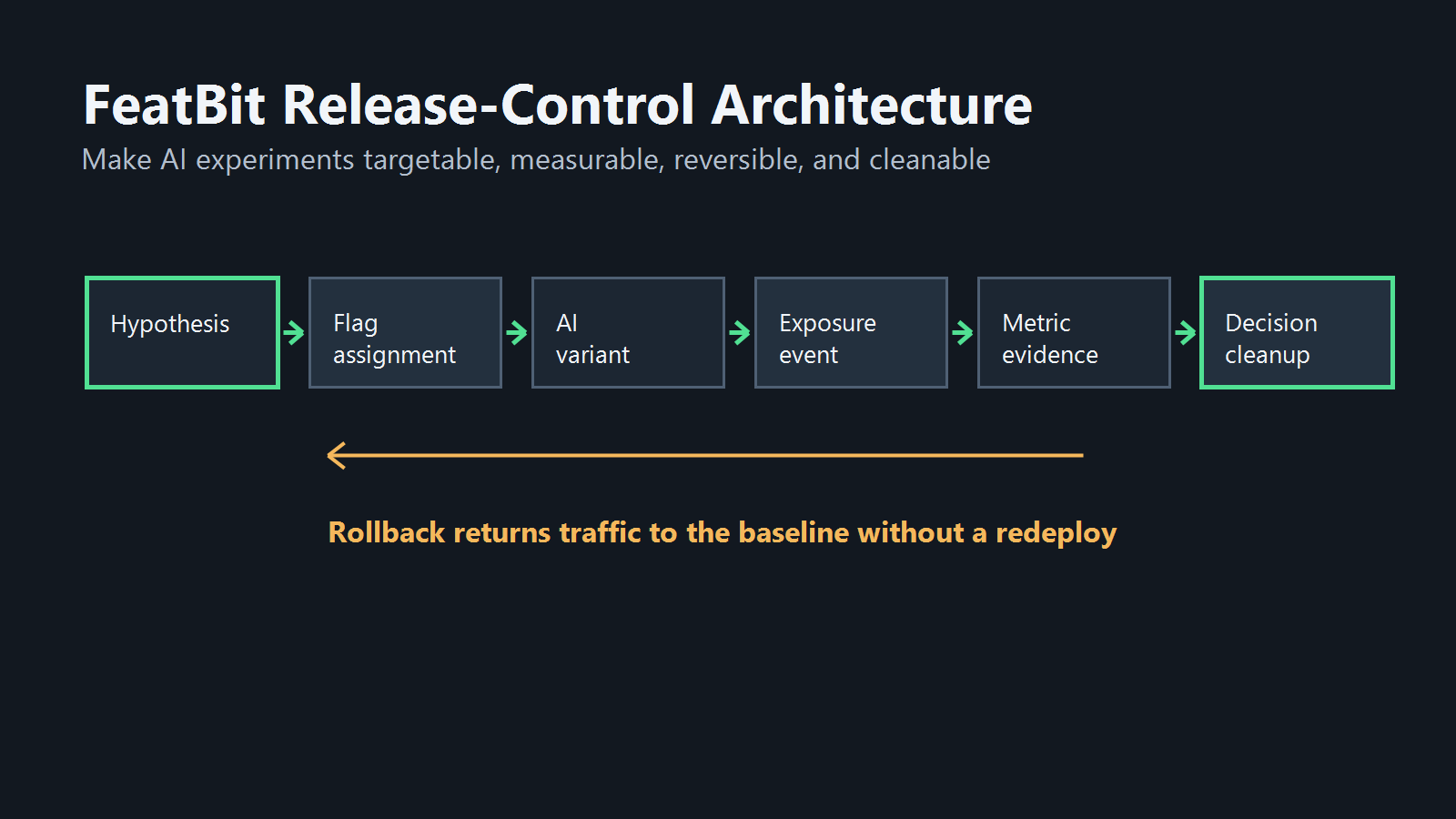
Start with a release hypothesis:
ai_release_hypothesis:
  question: should paid-account support chat use candidate_model_route by default?
  current_behavior: baseline_model_route
  candidate_behavior: candidate_model_route
  assignment_unit: account_id
  eligible_scope:
    environment: production
    segment: paid_accounts
    workflow: support_chat
  primary_outcome: resolved_without_escalation
  guardrails:
    - p95_latency
    - cost_per_resolved_case
    - fallback_rate
    - human_correction_rate
  rollback_when:
    - telemetry_missing
    - severe_quality_issue
    - guardrail_breach
  cleanup:
    after_decision: promote_winner_or_remove_losing_route
Then map the hypothesis to release controls:
- Create a multivariate flag for the AI behavior being tested.
- Target internal users or a low-risk segment first.
- Use percentage rollout only after early evidence is healthy.
- Emit an exposure event when the AI behavior actually runs.
- Send outcome and guardrail events through the same experiment key and assignment unit.
- Decide continue, pause, rollback candidate, ship winner, or inconclusive.
- Archive or clean up temporary branches after the decision.
FeatBit's docs for percentage rollouts, A/B testing, and the Track Insights API are the implementation primitives behind this pattern.
Compare The Two Options By Decision Criteria
Avoid vague comparison questions such as "Which platform has AI experimentation?" Both categories now use similar words: flags, experiments, metrics, agents, rollouts, guardrails, and cleanup.
Use criteria that expose the operating model:
| Criterion | Ask this about GrowthBook | Ask this about FeatBit |
|---|---|---|
| Primary center of gravity | Is experiment analysis in the warehouse the main reason to buy? | Is release control across flags, rollout, rollback, and lifecycle the main reason to buy? |
| AI control surfaces | Which AI surfaces become flags, experiments, metrics, or analytics dimensions? | Which AI surfaces become release decisions with targeting, rollback, audit, and cleanup? |
| Evidence ownership | Does the data team need SQL-visible metric definitions and warehouse-native analysis? | Does the release owner need exposure, outcome, guardrail, and rollback evidence in one control loop? |
| Agent participation | Can agents operate through MCP or REST with approvals and audit? | Can agents propose release controls while humans keep production exposure and cleanup reviewable? |
| Deployment model | Does GrowthBook cloud, self-hosting, or warehouse-native architecture fit your data posture? | Does FeatBit open-source or self-hosted control fit your platform and compliance posture? |
| Lifecycle | How are stale flags, experiments, and code references detected and removed? | How are experiment flags classified, reviewed, archived, and cleaned up after decisions? |
This comparison is intentionally not a ranking. It is a selection frame. GrowthBook and FeatBit both sit near feature flags and experimentation, but they can serve different centers of gravity.
Example: Replacing A Dashboard-First AI Experiment With Release Control
Imagine a team testing a new RAG profile for a support assistant. A dashboard-first workflow might start with a metric question: "Does treatment improve accepted answer rate?"
A release-control workflow asks more questions before traffic starts:
- Which users or accounts are eligible for the new retrieval profile?
- Which assignment unit stays stable: user, account, conversation, or workflow?
- Which event proves the candidate retrieval profile actually served the answer?
- Which guardrails stop expansion even if the primary metric improves?
- Which fallback returns the assistant to the baseline retrieval profile?
- Which owner decides whether to continue, pause, roll back, or ship?
- Which prompt, index, metric, and flag artifacts are removed after the decision?
The metric still matters. It just does not stand alone. For AI changes, the release owner needs an operational answer while the experiment is running, not only an analysis report after the fact.
FeatBit's measurement design guidance is useful here because it separates the primary outcome from guardrails. FeatBit's feature flag lifecycle management guidance handles what happens after the experiment, when temporary controls either become default behavior, remain as deliberate operational controls, or get removed.
Migration Or Evaluation Checklist
If you are evaluating FeatBit as a GrowthBook AI experimentation alternative, do not begin with a full migration plan. Begin with one AI release workflow.
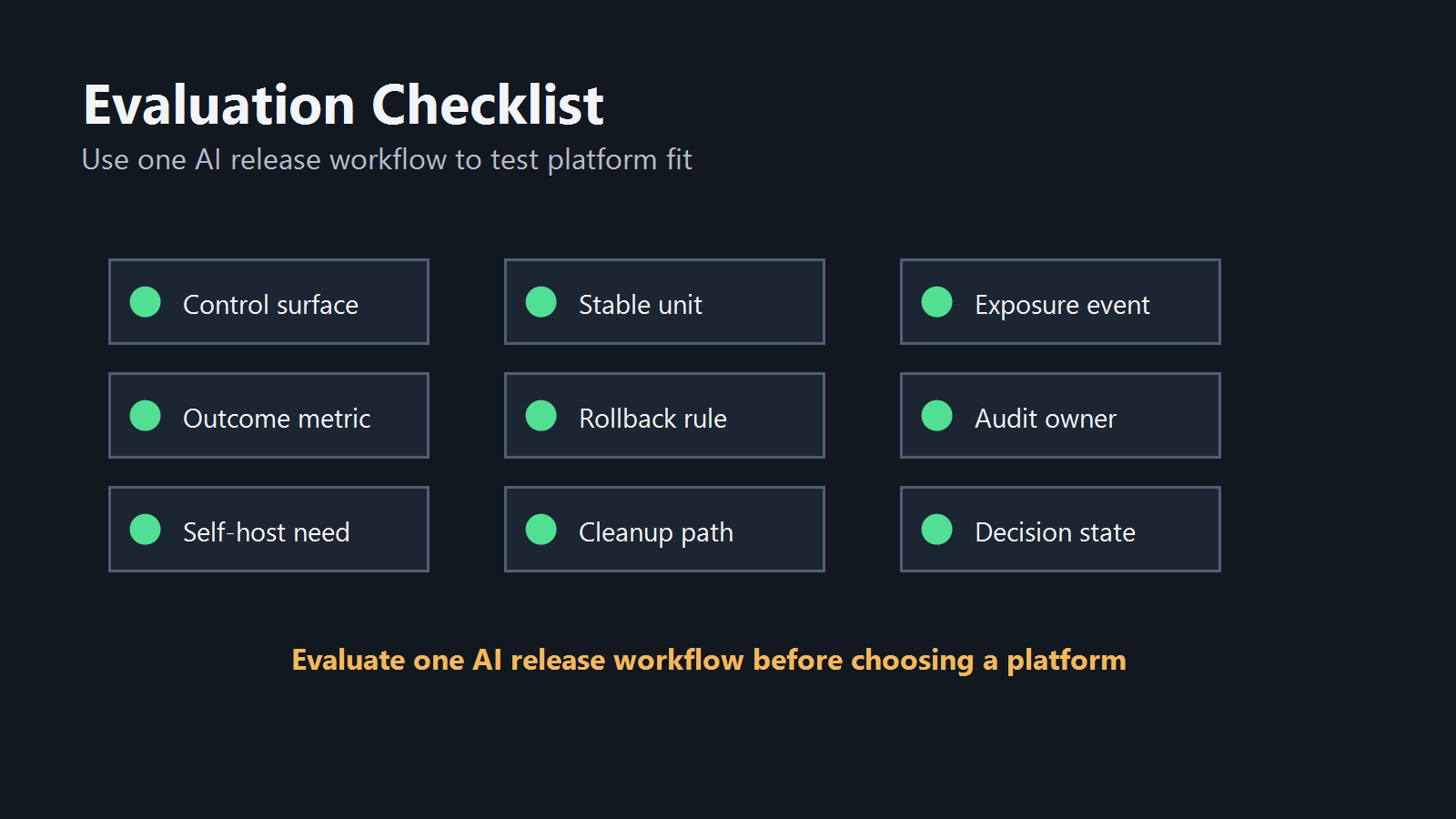
Use this checklist:
- Name the AI behavior that needs control: prompt, model route, retrieval profile, tool mode, fallback, or full feature.
- Define the release hypothesis before creating the flag.
- Choose the stable assignment unit and eligible segment.
- Identify the baseline behavior and verify it can stay available at runtime.
- Define the primary metric and two to four guardrails.
- Confirm exposure and outcome events can be joined.
- Decide who can change production targeting and rollout percentage.
- Confirm audit history and approval expectations.
- Decide whether the control plane must be self-hosted.
- Write the cleanup rule before the first user enters the experiment.
If these questions are hard to answer, the issue is not only vendor selection. The release operating model needs more design before any platform can make the experiment trustworthy.
Common Mistakes When Looking For A GrowthBook Alternative
Comparing only statistics features. Statistical engines matter, but AI experimentation also needs runtime controls, fallback behavior, observability, permissions, and cleanup.
Treating self-hosted as only a procurement checkbox. For AI experimentation, flag state, exposure events, metric events, audit logs, prompts, and rollout decisions can all become sensitive operational data.
Assuming agent-ready means agent-autonomous. Agents can draft flags, experiment plans, event schemas, and cleanup pull requests. Production exposure changes still need permissions, review, and audit.
Using one flag for too many AI decisions. Prompt, model, retrieval, tool, and fallback changes can have different risk profiles. Separate controls make rollback and evidence easier to interpret.
Forgetting the losing variant. The experiment is not finished when a dashboard declares a winner. Remove or archive the losing prompt, route, event name, and temporary flag code according to the lifecycle rule.
Bottom Line
GrowthBook is a reasonable option when the main job is warehouse-native experimentation, product analytics, and agent-accessible experiment operations. FeatBit is a strong alternative when the main job is release control for AI behavior: targeted exposure, stable assignment, metric evidence, rollback, auditability, self-hosted ownership, and lifecycle cleanup.
For AI teams, the best platform is the one that matches the decision you actually need to make. If the decision is "which metric won in the warehouse," evaluate GrowthBook carefully. If the decision is "which AI behavior should be exposed, expanded, rolled back, and cleaned up under release governance," evaluate FeatBit as the control plane.
Source Notes
- GrowthBook vendor context: GrowthBook's AI software page, experimentation product page, feature flags product page, warehouse-native platform page, AI-native development page, and documentation overview are used for public positioning, experimentation, feature flag, warehouse, agent, self-hosting, and governance context. This article does not make performance, pricing, security, compliance, customer, or market-ranking claims about GrowthBook.
- FeatBit implementation context: AI experimentation, AI control layer, safe AI deployment, feature flags as release-decision infrastructure, measurement design, feature flag lifecycle management, percentage rollouts, A/B testing, and the Track Insights API support the release-control workflow described here.
- Internal reader journey: for a broader vendor-aware checklist, read GrowthBook AI experimentation: a release-control evaluation guide. For concept depth, continue with AI-native experimentation and feature flags, A/B testing for LLM prompts, and AI benchmarks vs real-user outcomes.
Image And Open Graph Notes
- Use
cover.pngas the Open Graph image because it positions the page as an alternative-selection guide, not a generic experimentation explainer. - Use
alternative-decision-map.pngnear the opening because it shows how the buyer decision splits between experiment analysis and release control. - Use
release-control-architecture.pngin the workflow section because it makes the FeatBit operating model concrete. - Use
evaluation-checklist.pngnear the checklist because it gives teams a practical evaluation artifact while keeping the full guidance crawlable in text.